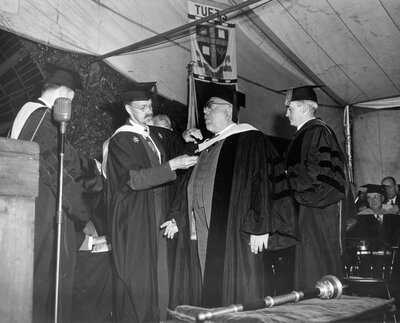
1909: An Early Start in Mathematics
A world-renowned mathematician and creator of the science of cybernetics, Norbert Wiener, A1909, entered Tufts as a younger than average student, receiving his bachelor’s degree at age 14. Throughout his career Wiener was plagued by poor eyesight, which prevented him from studying zoology and later from joining the military. However, this led him first to a Ph.D. in philosophy at Harvard and then to a professorship at MIT, during which he made his most influential contributions to twentieth‑century mathematics. Through his work, Wiener helped shape modern mathematical analysis and laid foundations for areas such as stochastic processes, signal processing, and systems theory, significantly impacting both mathematics and engineering. At its core, cybernetics is based on common relationships between humans and machines. It is used today in control theory, automation theory, and computer programs to reduce time-consuming computations and decision-making processes formerly done by human beings.