The Man of Signs
Some almanacs used a "Man of Signs" woodcut to indicate the moon's place, rather than information in a table. This illustration, sometimes called the "anatomy," labeled parts of a man's body to indicate which body parts were governed by which zodiac sign and to guide blood letting.
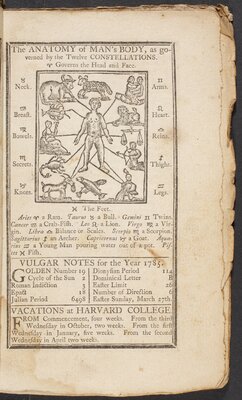
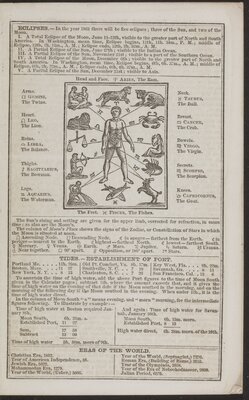
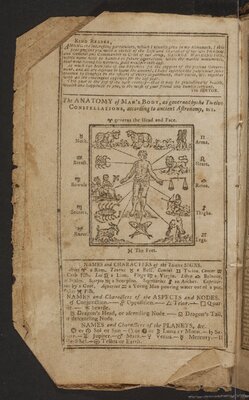
It is estimated that the Man of Signs appeared in about three-quarters of the almanacs published around 1760. By the end of the century, it appears in only about one-third, when the underlying occult influences of the figure, which dated back to the Middle Ages, became an embarrassment. In later volumes, the Man of Signs was often printed with "disparaging commentary" explaining that it was included only to appease less-educated readers with an interest in astrology¹.
¹Peter Eisenstadt, “Almanacs and the Disenchantment of Early America,” Pennsylvania History: A Journal of Mid-Atlantic Studies 65 no. 2 (2000): 155-156.